
Introduction
In today's white appliance R&D, water quality detection has shifted from 'icing on the cake' to a necessity. Water purifiers need to remind users to replace filter elements based on water quality changes; smart water dispensers hope to display TDS values in real time to prove purification effect; coffee machines need to monitor inlet water hardness to match extraction curves—the common foundation behind these functions is a stable, reliable conductivity/TDS measurement unit.
When receiving product requirements, R&D teams usually first evaluate a 'classic path': use an MCU with op-amps, analog switches, and a few passive components to build the measurement front-end themselves. This solution seems to offer strong control and low BOM cost, but only those who have actually done it know that this path is full of analog circuit pitfalls and uncertainties in mass production consistency.
In contrast, dedicated water quality detection chips, typically represented by AtomBit, encapsulate the core knowledge of conductivity measurement in silicon, freeing engineers from heavy analog debugging and calibration algorithm development. This article, based on AtomBit's BA series conductivity/TDS interface ASICs, from the perspective of a white appliance R&D engineer, discusses the true advantages of dedicated chips in white appliance development from dimensions such as development speed, technical threshold, reliability, and overall cost, and how to use them effectively in actual projects.
Self-Developed Water Quality Detection Module: Seems Simple, But Full of Challenges
The Deep Pitfalls of Analog Front-End Design
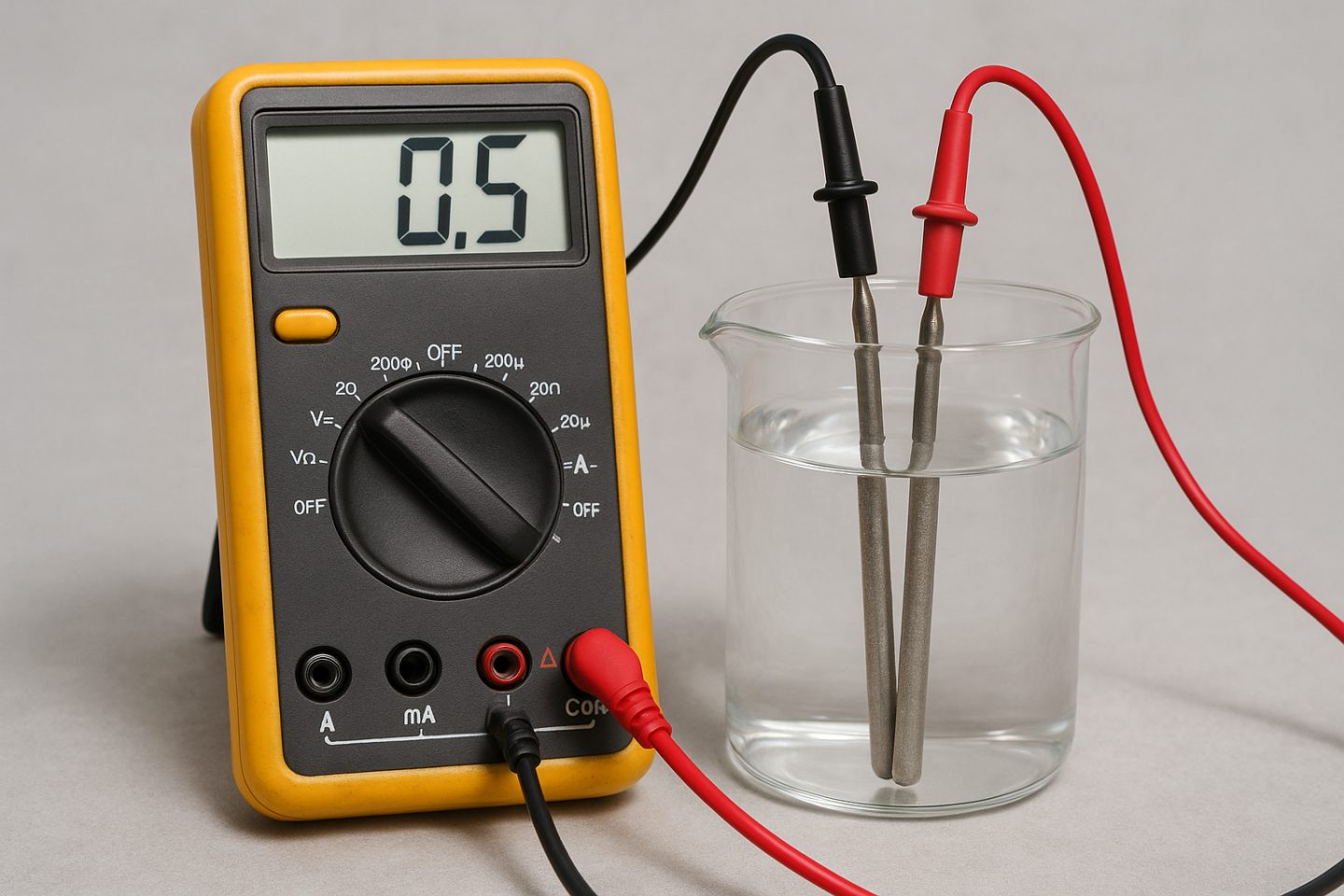
The physical principle of conductivity measurement is not complex: place a pair of electrodes in a liquid, apply AC excitation, measure the current flowing through the solution between the electrodes, and convert it to conductivity based on the electrode constant. But turning this principle into a reliable circuit requires overcoming a series of engineering challenges.
First is the design of the excitation source. DC excitation causes electrode polarization, leading to unpredictable errors and accelerating electrode damage. Therefore, AC excitation must be used, typically square wave or sine wave. Square wave circuits are simple but have complex harmonic components and are susceptible to power supply noise; sine waves have low distortion but require precise waveform generation circuits, increasing cost and complexity.
Second is weak signal detection. The conductivity of pure water is very low (can be below 1 µS/cm), and the current flowing through the electrodes is at the microampere or even nanoampere level. To amplify, filter, and convert this signal to digital, careful design of transimpedance amplifier (TIA) gain, filter cutoff frequency, and ADC reference voltage is required. Any rough PCB grounding or layout error can introduce unacceptable power frequency interference.
Third is temperature compensation. The conductivity of a solution changes significantly with temperature, typically about 2% per degree Celsius. To obtain comparable measurement results, the real-time conductivity must be converted to a standard value at 25°C. This means additional high-precision temperature sensor circuitry (such as NTC resistor divider) must be designed, and temperature compensation algorithms written into the MCU. For engineers without a background in fluid thermodynamics, the selection of coefficients for linear compensation formulas often requires repeated trial and error.
Finally, there is probe adaptation and protection. The electrode leads need AC coupling to avoid DC bias damaging the electrodes; long cables may introduce additional distributed capacitance, affecting measurement accuracy. Improper handling of these details can lead to measurement fluctuations in mild cases or product failure in the user's home in severe cases.
The Nightmare of Calibration Consistency
After completing prototype debugging of the self-developed module, greater pain awaits in mass production. The analog circuit parameters of each board have distribution: op-amp input bias current, resistor accuracy, reference voltage drift... To keep the whole machine measurement error within ±5%, each unit must be calibrated. Conductivity calibration relies on standard potassium chloride solutions, and manual operation is extremely inefficient, with liquid evaporation and contamination introducing errors. Even with automated production lines, cleaning fixtures and replacing standard solutions take up considerable takt time.
Moreover, the calibration process itself is difficult to close-loop. If, to save costs, the onboard temperature sensor is omitted and only a compensation table is used, then once the on-site water temperature deviates from the calibration environment temperature, accuracy drops sharply. Ultimately, R&D personnel have to painfully choose between 'full inspection calibration before shipment' and 'accepting larger factory errors'.
Hidden Costs of Production Maintenance
The 'surface cost' of the BOM often deceives project managers. A discrete solution may only need a few low-cost op-amps and resistors, but considering the higher requirements for PCB (4-layer boards are more stable), additional test fixtures, calibration personnel hours, quality inspection sampling ratios, plus later maintenance and brand damage caused by customer complaints, the 'cheap' discrete solution is likely more expensive than a chip solution.
More importantly, once a certain op-amp is discontinued or its ESD level fails to meet new national standards, the product needs to be redesigned and verified, and engineers fall into a pile of circuit changes with no added value. These hidden costs are rarely fully assessed at project initiation, but they genuinely slow down product iteration speed.
AtomBit Water Quality Detection Chip: The Simplifier and Game-Changer
Facing the above pain points, AtomBit has launched the BA series conductivity/TDS dedicated interface chips, covering single-channel, dual-channel, wide-range, and micro-package categories. These chips compress the complete conductivity measurement pipeline—from bipolar probe excitation, weak signal conditioning, high-resolution ADC, to temperature compensation algorithms and digital communication—into a fingernail-sized ASIC, making water quality detection unprecedentedly simple.
Hardware Integration Comparison
Taking a typical single-channel conductivity detection as an example, if a discrete solution is used, the BOM typically includes:
- 1 MCU (must have built-in DAC to generate excitation waveform, or external signal generator)
- 1–2 precision op-amps
- Analog switch or multiplexer
- Reference voltage source
- Several resistors and capacitors (at least 10)
- Temperature sensor and its signal conditioning circuit
This results in a PCB area of at least 30 mm × 30 mm, and routing must strictly follow analog signal rules. If instead choosing AtomBit's BA121 (single-channel conductivity interface ASIC), the peripheral components are only a few power decoupling capacitors and probe connection terminals, plus a minimal MCU reading data via UART. The complete water quality detection sub-board can be compressed to within 15 mm × 10 mm, or even placed directly on the main board nearby, no longer requiring an independent analog 'clean ground'.
Development Practice: The Leap from Discrete Circuits to Single-Chip Solutions
I once experienced the dilemma of developing TDS detection for a desktop water purifier using a discrete solution: two engineers spent 4 months debugging excitation timing and filter parameters, and another 2 months optimizing the calibration process on the production line, yet the final product still had about 3% customer complaints related to measurement inaccuracies. Later switching to BA012 (dual-channel TDS interface ASIC), the entire development process changed qualitatively:
- Hardware Design: Referring to AtomBit's typical application circuit, from schematic to layout review took only one week. BA012 has built-in bipolar probe drive, eliminating the need to design an AC excitation circuit; the probe connects directly to the chip's two channel pins. Temperature compensation is also built-in, no longer requiring a separate NTC network.
- Software Development: The MCU only needs to send simple commands via UART, and BA012 returns two channels of already temperature-compensated TDS values (unit ppm). Firmware development time was no more than 3 days, with the remaining work mainly implementing display and filter life algorithms, not wrestling with analog signals.
- Calibration Process: Since the chip is laser-trimmed at the factory and includes patented conversion algorithms and temperature compensation curves, the unit-to-unit consistency is extremely high. We only needed to do a single-point verification on a few golden samples, confirming the readings were within ±2% of the standard solution reference value. Production line testing only required checking communication and reasonable readings, eliminating the per-unit liquid calibration station.
As a result, the entire water quality detection function development cycle from project initiation to small-batch trial production took only 8 weeks, with less than one-third of the manpower, and subsequent customer complaints dropped to zero. This fully demonstrates the core value of dedicated chips being 'plug-and-play'.
Rapid Verification and Batch Deployment
AtomBit chips generally adopt UART digital output, directly connecting to the main controller without additional analog conversion. Engineers can quickly observe measurement values using a serial port assistant during prototype debugging, greatly shortening debugging time. For scenarios requiring multi-point water quality comparison (such as TDS comparison before and after RO membrane), BA012 or BA112 (dual-channel wide range) provides a natural dual-channel design, one chip simultaneously collecting inlet and outlet water, firmware directly calculating salt rejection rate, no longer requiring multiple chips for synchronous sampling.
For ultra-compact products (such as smart water cups, portable TDS pens), BA311 in SOT23-6 package, a micro TDS chip, is even more advantageous. It can automatically complete a measurement frame in 300 ms at 3.3V supply and actively push data in BURST mode, without even needing a UART wake-up pin. The water-side PCB of a smart water cup is often only the size of an index fingertip; a discrete solution cannot fit at all, but BA311 can easily be embedded in the tail of the probe holder.
Selection Decision Guide: How to Match the Most Appropriate Chip for White Appliance Products
AtomBit's BA series provides a fine product division for different white appliance scenarios. From the mass-produced product library, a clear selection logic can be summarized:
Single-Channel vs Multi-Channel
- Single-channel: Suitable for single-point monitoring scenarios, such as water dispenser outlet, coffee machine boiler inlet. Recommended are BA121 (0–6000 µS/cm) or BA311 (0–3000 ppm TDS, SOT23-6). If measuring pure water and high resolution is needed, use BA121S (0.1 µS/cm resolution, low range).
- Dual-channel: Typical scenario is water purifier inlet/outlet comparison, such as RO machines, ultrafiltration machines. BA012 (dual 0–3000 ppm TDS) or BA022 (dual 0–6000 µS/cm) offer excellent cost performance. If a larger range is needed (e.g., wastewater or raw water with high TDS), BA112 provides dual-channel wide range of 0–10000 ppm, and includes probe floating/NTC short circuit diagnostics for higher safety.
- Three channels and above: For multi-stage purification systems, BAT3U offers three channels, simultaneously monitoring raw water, first-stage product water, and second-stage product water.
Range and Accuracy Selection
The TDS of water purifier product water is typically 0–50 ppm, so low-range accuracy must be considered. BA121S is specifically designed for this, with 0.1 µS/cm resolution capable of reliably distinguishing subtle RO membrane degradation. For monitoring municipal tap water or pre-treatment water, the ranges of BA121 or BA022 are sufficient. For high-hardness areas or purifiers with mineralization filters, outlet TDS may reach 200–500 ppm, BA311L (wide range 0–10000 ppm) ensures no overload.
Temperature Sensor Interface
Most chips (such as BA121, BA012) have a built-in temperature acquisition channel that can directly connect to the probe's integrated NTC or PT100, automatically completing temperature compensation. If the probe itself does not include a temperature sensor (e.g., a pair of bare metal electrodes) and an external temperature probe is needed, BA112 can be selected, as it provides two additional independent temperature channels for connecting standalone temperature probes, enabling multi-zone temperature monitoring.
Probe and Structural Integration
The chip only completes measurement and digitization; actual coupling to the water flow requires electrodes. AtomBit offers planar ring electrodes TFE-1-A1, TFE-304-M6, etc., supporting secondary injection molding, suitable for water purifier waterway insert designs. There are also standard 3/8-inch quick-connect digital probes with built-in titanium/gold/platinum electrodes and temperature sensors, directly outputting digital signals, ideal for water dispensers, coffee machines, and other fast-installation scenarios.
During selection, engineers can first use standard probes in prototype water paths for actual measurement, obtain raw data, and then decide based on product structure whether to customize electrode in-mold injection or directly use digital probes. The chip and probe interfaces are fully standardized, and changing probe specifications does not require PCB modification.
Engineering Implementation Points and Reliability Assurance
Probe Connection and Anti-Interference
AtomBit chips use bipolar excitation, effectively suppressing electrode polarization, but attention should still be paid to probe cable shielding. For long cable applications, it is recommended to use shielded wire and ground the shield at a single point (to the chip ground). BA112 has a probe floating detection function that can report an anomaly when the probe contact is poor, preventing the MCU from using erroneous data for misjudgment.
Correct Use of Temperature Compensation
Although the chip automatically compensates, the compensation coefficients depend on built-in algorithms. For scenarios beyond the chip's preset temperature range (e.g., 0–100°C) or special water samples (e.g., high-temperature electrolyzed water), external correction may be needed. Fortunately, the chip provides raw uncompensated ADC values (readable via UART), allowing engineers to perform secondary compensation based on their own models. However, during verification, note that the chip's temperature compensation has been trained on a large number of samples, and in most scenarios, direct use is the optimal solution.
Long-Term Drift and Consistency Verification
The chip itself has extremely low drift, but probe surface scaling and contamination can cause long-term drift. It is recommended to guide users in the product manual to periodically clean the probe (e.g., soak in citric acid), or design self-cleaning functions in the structure (e.g., turbulent water flow self-cleaning). During verification, sample units can be placed in 60°C hard water (simulating aging) and continuously run for 1000 hours, comparing measurement offset before and after, which should typically not exceed 2% of FS. For RO machines, periodically flush the probe with standard 500 ppm sodium chloride solution to verify readings.
Emphasis: All chip-based measurements should be used for on-site screening and trend monitoring, and cannot replace laboratory regulatory certification. If the product claims to meet drinking water hygiene standards, water samples must be sent to a third-party laboratory for testing; chip readings serve only as internal reference.
Limitations and Applicability of Chip Solutions
Although dedicated chips have significant advantages, they are not a silver bullet. Their limitations should be rationally recognized:
- Fixed parameters: The chip's measurement range, excitation frequency, and ADC resolution are fixed in the chip definition. If future requirements change to measuring the conductivity of oil or extremely high peak currents, it may be necessary to revert to discrete design. However, for household water purification and drinking water fields, the existing 0–10000 ppm range covers the vast majority of scenarios.
- Not metrological accuracy: AtomBit chips have an accuracy of around ±2% FS, sufficient for water purifier effect display and filter life estimation. But they cannot reach the level of laboratory conductivity meters (±0.5% of reading). If the product is positioned as a professional detection device, a higher-end design may be required.
- Supply chain lock-in: Adopting a dedicated chip means the probe must also match the chip (drive voltage, frequency, etc.). Long-term, ensure AtomBit's supply stability. Fortunately, AtomBit chips are designed to be compatible with standard two-electrode probes, and backup options are not complicated.
- Thermal management: Although the chip is low power, if placed close to high-temperature piping (such as instant hot water dispenser outlet pipes), note that the chip's operating temperature is typically -40–85°C, so layout should keep it away from heat sources.
FAQ (Frequently Asked Questions)
Q1: Can the chip directly output conductivity values? A: Yes. All BA series chips output engineering units (µS/cm or ppm) via UART, with temperature compensation completed by default. For example, BA121 outputs conductivity (µS/cm), BA012 outputs TDS (ppm), with no need for MCU conversion.
Q2: Do I still need to calibrate myself? A: Usually not per-unit calibration. Chips are laser-trimmed at the factory with good consistency. However, it is recommended to verify a few samples with standard solutions early in product development; if deviation exceeds allowable range, a software overall offset correction can be made in the MCU. Production line testing can be limited to communication and functional tests.
Q3: How to ensure long-term stability? A: The chip's own drift is extremely low (< 0.1% FS/year), and long-term stability mainly depends on the probe. It is recommended to choose platinum or titanium electrode probes and design cleaning cycles or remind users to clean. The chip's built-in probe detection function (such as BA112) can promptly detect probe faults.
Q4: Can the chip be used to measure 100°C boiling water? A: The chip's operating temperature upper limit is 85°C, so it cannot be directly attached to boiling water pipes. Thermal isolation design should be used to keep the chip area below 85°C. For the probe, AtomBit's F9027 stainless steel NTC temperature probe can withstand long-term boiling water, but it must be used with the chip's temperature input channel.
Q5: Compared to imported similar chips, what advantages does AtomBit have? A: AtomBit is a local manufacturer, with fast technical support response, and can assist with structure, probe customization, and communication protocol adaptation. BOM cost and procurement lead time are more advantageous in large-scale production. The actual effects of its bipolar drive and automatic temperature compensation algorithms have been batch-verified in many white appliance manufacturers' projects.
Conclusion
Competition in white appliances has long entered the era of detail-driven success. If water quality detection chooses a self-developed discrete solution, it is equivalent to carrying a heavy development burden on an already crowded track. Dedicated ASICs like AtomBit's water quality detection chips transform complex analog measurements into simple digital reads, allowing R&D teams to spend precious time on user experience and algorithm innovation, not wrestling with op-amps and noise. For white appliance companies pursuing rapid market launch, stable output, and quality consistency, adopting chip solutions is not an alternative but a key guarantee of project success.
From water purifiers to smart water dispensers, from infant formula water warmers to professional coffee machines, water quality detection chips are making 'always visible water quality' a standard capability of every water appliance. As engineers, our responsibility is to choose the most reliable and efficient components; AtomBit's BA series undoubtedly provides a compelling choice.