
I. Why Content for Water Detective 1 to 4 Is Prone to Homogenization
Water Detective 1 to 4 all cover parameters such as TOC/COD/TDS, so promotional content easily falls into the trap of "repeated parameters and similar messaging." If you merely list parameters by model, readers will conclude that the four products are not fundamentally different. The real question to answer is: for water purifier brands, product managers, embedded engineers, hardware R&D teams, and OEM customers, which specific task does each generation of test pen solve? The content matrix should be broken down along four dimensions—user tasks, usage scenarios, educational focus, and service workflow—rather than simply repeating "multi-parameter, portable, fast."
II. First Establish a Unified Product Boundary
All Water Detective models are portable rapid testing/screening tools for scenarios such as domestic water, on-site screening, water purification services, and aquaculture testing. They cannot replace laboratory testing required by regulations; in particular, optical COD/TOC/UV254 indicators are better suited in portable devices as trend indicators and for rapid comparison, not as standard analytical methods. Content marketing must first clarify this boundary to avoid misleading users into treating consumer-grade screening values as compliance reports. This is also the common premise for differentiating content across all subsequent models.
III. Split the Content Matrix by User Task
3.1 Brands and Product Managers: Model Selection and Scenario Validation
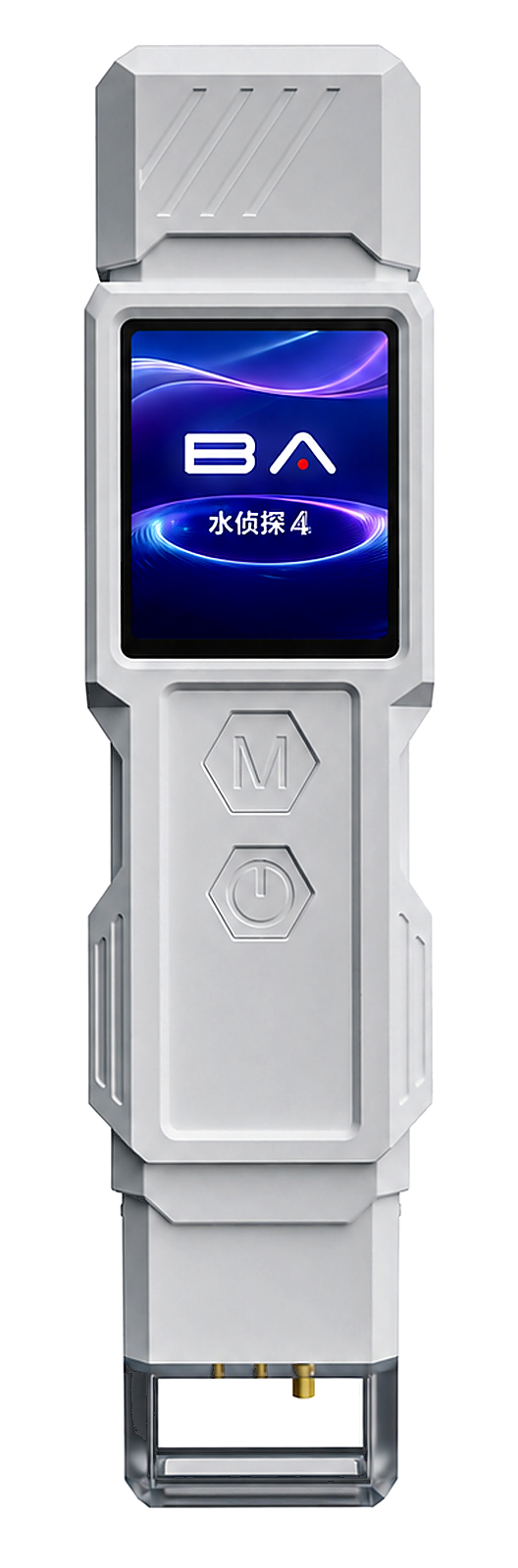
Brands and product managers care more about overall unit function validation, filter life performance, and after-sales service experience. They need to quickly compare multiple water samples to determine whether the water purifier meets expected results. In this case, the nine indicators of Water Detective 4 (TOC, COD, UV254, TDS, EC, turbidity, hardness, salinity, temperature) are better suited for comprehensive evaluation; the Bluetooth mini-program function and six indicators of Water Detective 3 suit service personnel for on-site records and data upload; the standalone screen display of Water Detective 2 suits rapid in-store demonstrations; Water Detective 1 can serve as a basic screening tool for intuitive observations such as color and turbidity.
3.2 Embedded Engineers and Hardware R&D: Measurement Chain and Integration Validation
Embedded engineers and hardware R&D teams focus on the conductivity/TDS measurement chain behind portable devices, temperature compensation, probe consistency, and calibration methods. Although the Water Detective series itself consists of finished test pens rather than modules intended for direct embedding, it can serve as a reference measurement tool during development to help teams validate conductivity/TDS trend changes in target water samples. When integrating detection capability into water purifiers, water dispensers, coffee machines, and other equipment, additional design is required for a conductivity/TDS interface ASIC, matching probes and temperature sensors, as well as completion of temperature compensation algorithms and mass-production calibration. Content should focus on explaining: why temperature compensation has a major impact on TDS/EC readings; how to choose probe materials and structures; and how to design the calibration process.
3.3 After-Sales Service and Filter Management
After-sales service personnel need to quickly determine whether a filter has failed while minimizing operational steps. The standalone screen display of Water Detective 2 suits on-site quick testing without a phone; the Bluetooth records of Water Detective 3 suit work-order management and historical trends; Water Detective 1 and 4 can be used for basic inspections and in-depth troubleshooting, respectively. Filter management content should revolve around "before-and-after replacement comparison" and "threshold determination," rather than giving only an absolute value.
3.4 OEM/ODM Customers: From Validation to Mass Production
OEM/ODM customers need to determine at the product definition stage which parameters are worth built-in detection and how to balance cost with mass-production consistency. Portable test pens can be used for incoming water screening, finished-unit function sampling, and after-sales training, but they cannot directly replace built-in sensors in equipment. Before entering mass production, the validated measurement chain also needs to be migrated to AtomBit's conductivity/TDS interface ASIC, temperature sensing, and probe solutions, along with completion of whole-unit EMC, water-path usability, and calibration fixture design.
IV. Design Differentiated Content by Usage Scenario
The same test pen should have different content emphases in different scenarios:
- Water Detective 1: Suited for entry-level screening, color and turbidity observation; content focuses on "understanding basic parameters" and "quick comparison of tap water and purified water."
- Water Detective 2: Suited for standalone testing of drinking water and purified water without phone dependency; content focuses on "single-point readings and on-site judgment."
- Water Detective 3: Suited for compact on-site testing and service records, with Bluetooth connection to a mini-program; content focuses on "continuous monitoring, data export, and trend analysis."
- Water Detective 4: Suited for comprehensive screening and overall evaluation, including more indicators such as hardness and salinity; content focuses on "multi-parameter interpretation, scenario expansion, and in-depth troubleshooting for water purification services."
V. Build a Content Ladder by Educational Focus
Content marketing should not dump all technical details on readers at once; instead, it should be layered by educational stage:
- Awareness level: Explain the basic concepts of TDS, EC, and temperature compensation, and avoid the misconception that "the lower the value, the better."
- Understanding layer: Explain why multiple parameters need to be viewed together, and the differences between portable optical indicators and laboratory methods.
- Application layer: Demonstrate how to use different models to judge water purifier filter replacement, screen aquarium water, compare bottled water, and more.
- Advanced layer: For engineers and OEM customers, provide in-depth explanations of the conductivity measurement chain, temperature compensation algorithms, probe selection, calibration, and mass-production validation.
In this way, WD1 content focuses on the awareness layer, WD2 focuses on single-point operations at the application layer, WD3 focuses on data logging and service workflows, and WD4 focuses on multi-parameter integration and advanced integration.
Six. Coordination of service workflow and content touchpoints
From pre-sales to after-sales, different stages require different content formats and model focus. The following table illustrates a reference configuration for the content matrix:
| Service stage | Primary user task | Recommended model focus | Content format |
|---|---|---|---|
| Awareness/selection | Understand portable detection capabilities and the meaning of parameters | WD1 / WD4 | Popular-science articles, parameter explanations |
| Evaluation/prototype | Compare multiple water samples and verify purification effects | WD4 | Comparison test videos, scenario cases |
| Integration/development | Verify the conductivity/TDS measurement chain and temperature compensation | WD2 / WD3 | Engineering guides, design notes |
| After-sales/service | Quickly determine filter status on site and record it | WD2 / WD3 | Operation checklist, troubleshooting |
| Mass production/acceptance | Incoming water screening and finished-product sampling inspection | WD1 / WD4 | Verification process, SOP |
7. Engineering Problems and Model Selection Decision Methods
7.1 Common Engineering Problems
- Poor repeatability: the probe is not rinsed thoroughly, the water sample has not returned to room temperature, or the measurement interval is too short.
- Missing temperature compensation: TDS/EC readings are significantly affected by temperature; without compensation, data from different time periods is not comparable.
- Misuse of optical indicators: portable COD/TOC/UV254 readings are treated as directly equivalent to laboratory standard method results.
- Incomplete data records: only a single value is recorded, ignoring temperature, measurement time and water sample status.
- Probe contamination: suspended solids or oil in the water sample adhere to the probe surface, causing conductivity measurement drift.
7.2 Model Selection Decision Methods
When choosing a Water Detective model, it is recommended to evaluate in the following order:
- Clarify the user task to be solved: is it basic screening, on-site recording, comprehensive assessment, or after-sales rapid testing?
- List the on-site conditions and operators: is a mobile app needed? Is direct on-screen display needed? Is the operator an engineer or a service person?
- Parameter coverage: are additional indicators such as turbidity, hardness and salinity needed? If only TOC/COD/TDS is needed, WD2 is sufficient; if Bluetooth and UV254/EC/temperature are needed, WD3 is more suitable; if the maximum number of parameters is needed, WD4 is the latest choice.
- Data management: are history records and export needed? The WD3 Bluetooth mini-program is more conducive to digitalizing service processes.
- Cost and portability: more basic models have advantages in procurement cost and training cost.
7.3 Implementation Steps: Verification Process for Water Purifier OEM Teams
The following steps apply to OEM teams that want to use the Water Detective series as a development verification tool:
- Establish baseline water samples: prepare at least three water samples, such as raw water, water passing through the RO membrane, and water passing through post-positioned activated carbon.
- Control temperature: place all water samples until they reach the same room temperature (around 25°C), and record the actual temperature during measurement.
- Pre-treat the probe: rinse the probe according to the product instructions to avoid contamination and bubble adhesion.
- Measure multiple times: measure each water sample 3 times consecutively, and take the median or average value.
- Comparison with laboratory methods: Select some water samples and send them to a third-party laboratory for testing, then calculate the deviation range of the portable readings. This is only for internal judgment thresholds and is not used as compliance data.
- Record and formalize: Write the temperature, readings, deviations, and judgment results into an internal SOP, and provide synchronized training to after-sales service personnel.
VIII. Limitations and Boundary Conditions
- Portable test pens are affected by ambient temperature, water sample homogeneity, probe contamination, and cross-interference, so their measurement uncertainty is higher than that of laboratory methods.
- In portable devices, optical COD/TOC/UV254 measures surrogate signals or trends correlated with laboratory methods and cannot be directly converted into regulatory report values.
- The Water Detective series does not replace standard methods such as GB/T 5750 or EPA, nor is it used to issue legally valid test reports.
- Systematic differences may exist between readings from different models, so comparing the same project across different generations of equipment requires parallel validation first.
- The built-in conductivity/TDS testing of the device differs from the measurement conditions of the portable pen, so the portable pen's judgment thresholds cannot be directly applied.
IX. Verification Methods
- Repeatability verification: Measure the same water sample 5 times consecutively, calculate the standard deviation or range, and determine whether it is within an acceptable range.
- Temperature compensation verification: Use a standard solution with known conductivity and measure at 15°C, 25°C, and 35°C respectively to check whether the compensated readings are close to the nominal value.
- Data logging verification: For WD3, check whether the data transmitted via Bluetooth is complete and whether the timestamps are correct.
- Comparison with laboratory: For internal deviation assessment only, select at least 2 samples per batch of water samples for third-party laboratory testing, and calculate the average deviation and relative deviation.
- Long-term stability spot checks: In after-sales scenarios, regularly calibrate the portable pen with the same standard solution and check for drift.
10. FAQ
Q1: Can the Water Detective 1/2/3/4 be used as laboratory test reports? No. They are portable rapid testing/screening tools intended for scenarios such as domestic water, on-site screening, water purification services, and aquaculture testing, and they do not replace laboratory testing required by regulations.
Q2: What is the relationship between TDS and conductivity (EC)? TDS is usually derived from conductivity, and the conversion factor depends on the water quality type and temperature. Reliable TDS readings depend on temperature compensation and calibration.
Q3: Why does WD3 have UV254 while WD2 does not? The product positioning differs: WD2 emphasizes a standalone screen display and simple, fast operation, while WD3 targets compact on-site testing and supports data logging via a Bluetooth mini-program, so it adds parameters such as UV254, EC, and temperature.
Q4: How can water purifier OEMs use these test pens to verify filter life? During the development stage, multi-parameter comparisons can be used to compare water quality changes before and after the filter, but this must be combined with the device's built-in sensors, temperature compensation, and laboratory comparison; do not rely solely on the absolute values of the portable pen.
Q5: How can content marketing avoid homogenization? Do not pile up parameters; instead, build a content matrix around user tasks, usage scenarios, educational priorities, and service processes, so that each generation of models corresponds to a clear set of tasks and operators.