
# How to Build a Credible Manual for Household Water-Quality Testing Products
Why the manual is part of the product's capability
For household water-quality testing products, especially TDS/conductivity sensors integrated into water purifiers, water dispensers, coffee machines, smart cups and pet water fountains, users do not directly touch the chip; they understand "water quality" through displays, apps or filter reminders. The manual is the key link that translates engineering parameters into executable, verifiable and non-misleading user language. Many customer complaints arise not because the sensor itself is inaccurate, but because the manual does not explain operating conditions, cleaning methods, the meaning of results and limitations.
For AtomBit's BA111 single-channel TDS sensor interface ASIC and the Water Detective 4 portable multi-parameter testing pen, credible manual development must distinguish two product categories: one is built-in continuous or quasi-continuous monitoring in a device, and the other is user-held spot-check screening. The two can share a manual framework, but the technical expression must be adapted to each.
First define the boundary of "credible": screening, feedback and trends, not compliance judgments
Household products generally do not have laboratory analysis conditions. Laboratory methods usually include fixed pre-treatment, standard curves, quality control samples, personnel operation and a report chain; household products quickly give a comparable number on site. The manual must state that the value is used for trends, comparison and device feedback, and is not a basis for legal limit determination. Even if the Water Detective 4 provides indicators such as TOC, COD, UV254, turbidity, hardness and salinity, these should be explained as multispectral rapid screening or portable on-site screening results, not as a replacement for professional testing.
For built-in TDS chips, for example BA111, which can measure 0–3000 ppm TDS with temperature correction, it is suitable for installation in the permeate line or tank of a water purifier to explain the difference before/after the membrane and whether the filter has entered the recommended replacement range. The manual should tell users what a rise or fall in TDS may indicate, but it cannot diagnose specific contaminants.
From the TDS/conductivity chip to the hand: four technical anchors for the manual
Taking BA111 as an example, manual writing must center on four technical anchors:
- range : 0–3000 ppm TDS. The manual must indicate the display strategy when above range, such as an over-range indication, and must not default to continued linearity.
- Temperature compensation : The sensor has built-in TDS temperature correction. However, the compensation is based on a typical water sample model; extreme temperatures, rapid temperature changes or non-standard water samples may cause residual errors. The manual should state the recommended operating temperature range and warn against sampling under freezing or overheating conditions.
- Bipolar drive : Reduces probe polarization and is suitable for long-term online use. However, bipolar drive cannot replace cleaning; the manual must still clearly define the periodic cleaning and re-testing procedure.
- UART control and minimal external circuitry : Easy to embed in water purifiers, water dispensers, coffee machines and similar equipment. For brand owners and integrators, the manual should include communication parameters, data format, and descriptions of status codes or error codes to facilitate production-line testing and after-sales diagnostics.
These anchor points mean the manual should not simply say "do not use for other purposes"; rather, it should translate the sensor's own engineering characteristics into actionable clauses.
Usage conditions: water sample, temperature, container and installation location
If the manual does not clearly state the conditions, users will draw wrong conclusions in the wrong scenarios. Usage conditions should at least include:
- Water sample state : Avoid bubbles, suspended solids and oil films; the sampling cup or tubing should be rinsed before measurement.
- Temperature : Before use, let the water sample come close to room temperature or the device's permitted operating temperature; do not insert the probe directly into a kettle being heated or into ice water.
- Container : Use a clean sampling container free of residue; plastic or glass containers should be rinsed to avoid detergent residue.
- Installation location : Online sensors should be installed in locations with stable flow velocity and where gas accumulation is unlikely; avoid proximity to elbows, pump outlets or locations where dry running may occur.
- Optical window : Multispectral products such as Water Detective 4 should be protected from direct strong light on the window, fingerprints and water stains, because contamination of the optical window directly affects optical indicators such as TOC, COD, UV254 and turbidity.
For the portable Water Detective 4, the usage conditions should emphasize the "on-site rapid testing procedure": sample, wait for stabilization, read, clean. Do not claim laboratory-grade accuracy, and do not suggest users apply it to scenarios such as sewage or industrial wastewater unless the product description explicitly covers them.
Cleaning, maintenance and re-testing: put "upkeep" in the manual, not in after-sales talking points
A trustworthy manual usually contains actionable cleaning and maintenance steps, and these steps must be something an ordinary user or on-site service person can complete. Suggested writing approach:
- electrode/probe cleaning : after powering off or removing, rinse with clean water, and if necessary gently wipe with a soft non-woven cloth; avoid scraping with hard objects. Bipolar drive reduces polarization, but long-term scaling will still affect readings, so regular cleaning and rinsing with pure water are recommended.
- optical window cleaning : wipe with a clean damp cloth, then dry with a soft dry cloth; avoid repeated rubbing of the lens with organic solvents or alcohol wipes.
- re-test procedure : measure the same water sample at least twice, recording each reading after it stabilizes; if the two differ greatly, clean again and take a new sample. For comparing water purifier inlet and outlet water, first run water to flush the lines for a period before sampling, to avoid the influence of stagnant water.
- maintenance records : if the product has an App or local storage, record the cleaning date, reference water sample readings and firmware version for after-sales diagnosis.
Interpreting results: better to give trends than to casually give "pass/fail"
The manual needs a "result interpretation guide". For TDS/conductivity products:
- displayed values : can display TDS ppm, conductivity μS/cm and temperature ℃.
- meaning of trends : a stable difference between water purifier inlet and outlet indicates the desalination or filtration process is normal; a sudden rise in outlet TDS may indicate membrane damage or seal failure; a slow rise over time may indicate the filter cartridge is nearing end of life.
- do not write : that TDS below 50 ppm is safe to drink directly, or that above a certain level it means "heavy metals exceed the standard". These judgments lack scientific basis.
For the multispectral metrics of Water Detective 4:
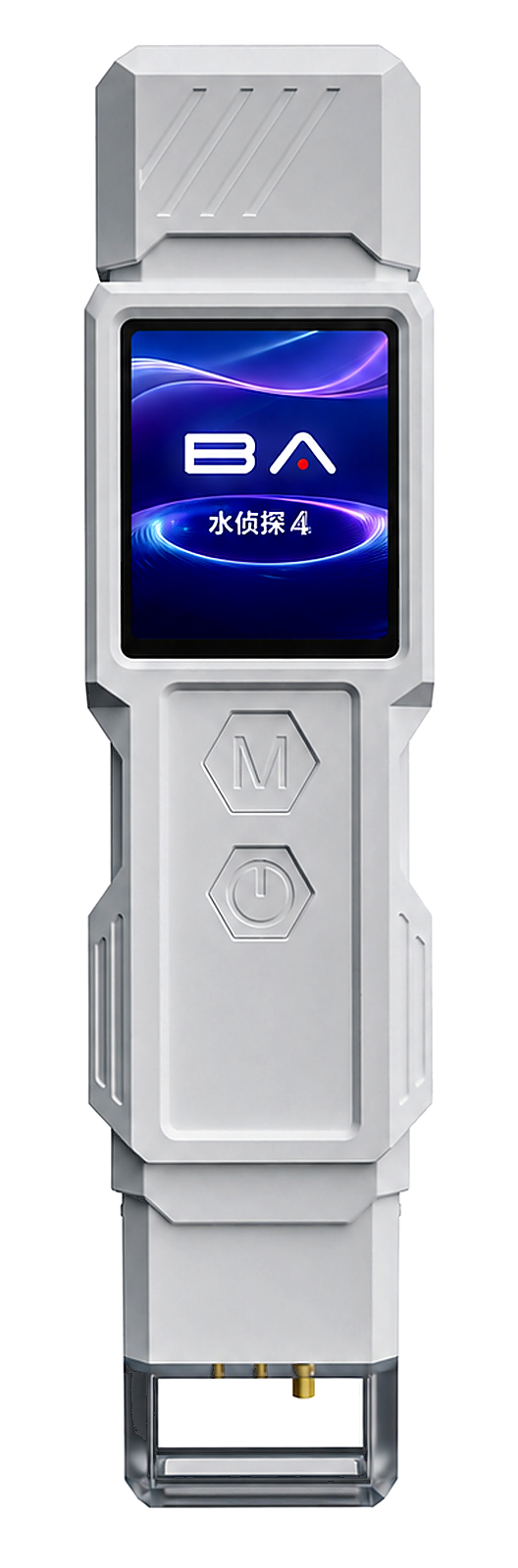
- TOC, COD and UV254 should be used as relative pollution trends or screening for differences between water samples; turbidity, hardness and salinity can help assess taste, scaling risk and similar factors. The manual may suggest that users compare the same water source at different times or compare different water sources, but it should not suggest equating a single reading directly with other laboratory reports.
It is recommended to use a table like the following in the manual to help users understand the boundaries:
| Product scenario | What can be explained | What should not be explained |
|---|---|---|
| Comparison of TDS in inlet and outlet water of a water purifier | Desalination trend, filter status indication | Determining whether water quality is acceptable or unacceptable |
| Water quality monitoring for water dispensers/coffee machines | Taste-related ion changes, scaling risk indication | Microbiological safety |
| Portable multi-parameter test pen | Time trends for the same water source, differences between water sources | Laboratory-grade quantification of contaminants |
Embedded integration and manual coordination: filter management and display logic
For smart small-appliance brands and embedded engineers, the manual has another reader: the integrator. BA111 is controlled via UART, making it easy for an MCU to read TDS and temperature. During integration, the manual should include:
- Sampling strategy: when to sample, the sampling frequency, and whether a delay is needed to wait for stabilization.
- Alarm threshold: how to set the filter replacement reminder threshold, but it must be stated that the threshold needs to be determined based on actual water quality, flow rate, filter type and life testing, and cannot rely on TDS alone.
- Display recommendations: show the TDS value, temperature value and trend indicator (such as rising/falling/stable) on the device panel; the filter reminder can display "check filter recommended" rather than "replacement required" to reduce false judgments.
- Exception handling: when temperature compensation is out of range, the probe is open or shorted, or data is abnormal, the device should display an error code or prompt to check the probe, rather than continuing to output potentially misleading values.
For integrators, a trustworthy manual needs to separate "displayed values" from "device status values." For example, the TDS data provided by BA111 is a raw or compensated sensor measurement, while filter life is the result of a higher-level algorithm; the two should not be conflated.
Selection and validation: the limits in a manual should come from testing, not imagination
Many manuals write limits as disclaimers, which actually makes them less credible. A more reasonable engineering approach is: first select the sensor solution based on product form and measurement range, then clearly document the limits through testing. A simple process:
- Define the goal: is it spot-check screening or online trending; which parameters are needed; whether UART output is required.
- Choose the sensor/ASIC: if only TDS/conductivity + temperature are needed, a single-channel ASIC such as BA111 can reduce external circuitry and development time; if multispectral on-site screening is needed, the Water Detective 4 provides multi-parameter portable detection.
- Define the installation or sampling method: pipeline, water tank, or handheld sampling.
- Define cleaning, calibration, or reference water samples: use a known conductivity standard solution or reference water sample to verify readings.
- Design the display and alarm logic: distinguish raw measurements, compensated values, trend judgments, and device faults.
- Write a draft manual: turn the above decisions into language that users and integrators can act on.
- Boundary testing: low temperature, high temperature, high TDS, long-term scaling, bubbles, flow changes, optical window contamination, etc.
- Revise the limitations: based on test results, write into the manual what cannot be measured and under what conditions use is not recommended.
Suggested verification methods:
- Test repeatability with low, medium, and high reference water samples within the range.
- Use a temperature step test to check the temperature compensation response.
- Use the change in readings after long-term scaling or contamination to determine the cleaning reminder interval.
- When performing correlation verification against laboratory methods, report only trend consistency and deviation range; do not claim equivalence.
Version management and multilingual synchronization
Manual versions should be linked to firmware versions and sensor algorithm versions. If temperature compensation coefficients, filter algorithm thresholds, or cleaning reminder intervals are adjusted later, the manual must be updated in sync; otherwise after-sales support will be chaotic. Multilingual versions should maintain the same technical limitations and should not weaken boundaries such as "not suitable for industrial wastewater" in translation.
FAQ
Q1: Can household water quality testing products tell me whether the water is safe? No. TDS/conductivity mainly reflects the total amount of dissolved ions and cannot identify microorganisms, specific heavy metal forms, or organic pollutant risks; multispectral screening is also rapid screening, not a compliance safety determination. The manual should guide users to refer to local drinking water standards or professional testing.
Q2: BA111 Does bipolar drive reduce probe polarization, so cleaning is no longer needed? Bipolar drive reduces polarization, but scaling, oil films, bubbles, and physical contamination can still interfere with readings. The manual still needs to provide cleaning and retest procedures.
Q3: Can the TOC/COD/UV254 measured by Water Detective 4 be used as a laboratory report? Not recommended. It provides portable rapid screening and multi-parameter trends, suitable for households, service personnel, and on-site screening. When legal or health conclusions are needed, send samples to a qualified laboratory.
Q4: When writing "accuracy" in a manual, what should be avoided most? Avoid writing only an isolated percentage without specifying the measurement range, temperature conditions, probe condition, and type of water sample being measured. A responsible approach is to provide the range, repeatability reference, temperature effects, and cleaning and maintenance requirements.
Q5: When users see TDS values fluctuating, what questions should after-sales ask? Ask for the product serial number, firmware version, water sample temperature, whether the probe has been cleaned, whether the sampling container is clean, whether the sample was taken after water was run, whether the reading is a single reading or a retest, and whether there are bubbles or an oil film. This information helps determine whether it is a usage issue or an equipment failure.
Conclusion
A credible manual does not hide risks; it puts product capabilities, usage conditions, cleaning and retesting, result interpretation, and limitations in front of users and integrators. For brands using AtomBit BA111 or Water Detective 4, the manual is part of the product. It determines whether a TDS chip in a water purifier is understood as "a numerical display" or "a credible trend," and whether a multi-parameter testing pen in users' hands is "a reference tool" or "a toy of overpromising."