
Smart laundry appliances are shifting from simple sequence control to adaptive control based on water-quality signals. Conductivity/TDS, as a low-cost water-quality indicator that can be measured online, can be used for program optimization, maintenance prompts and after-sales diagnostics. However, the internal environment of laundry appliances is complex, so sensors, interface chips, probe structures and temperature compensation must balance cost, size, reliability and mass-production consistency. Aimed at appliance R&D teams, this article discusses how to assess water-quality sensing needs in laundry appliances, and offers engineering recommendations in conjunction with AtomBit's BA121 and BA234 conductivity/TDS interface ASICs and OEM integration capabilities.
1. The role of water-quality signals in laundry appliances
Conductivity reflects the total amount of ions in water, and TDS is usually estimated from conductivity. In laundry appliances, water-quality signals are not used for compliance testing but serve as control inputs:
- Inlet water hardness/salinity : High-hardness water affects detergent efficiency and may cause scale; conductivity can be used to identify changes in inlet water quality and to interlock with a water softener or adjust the program.
- Detergent concentration and residue : The conductivity of the wash liquor rises as detergent dissolves and falls as residue decreases during rinsing, which can be used to determine the rinse endpoint.
- Maintenance prompts : Persistently high abnormal conductivity may indicate excess detergent, abnormal inlet water or scaling on the sensor surface.
- After-sales diagnostics : Recording water-quality trends can assist remote fault localization.
It must be made clear that this is a trend indication and feedback signal, not laboratory analysis; different detergents and water quality in different regions will cause baseline differences, so application calibration is essential.
2. From engineering questions to sensing requirements
When assessing water-quality sensing needs, it is recommended to proceed from the following engineering questions:
- Measurement target: Do you need to monitor inlet water, wash liquor or rinse water? Each medium has a different conductivity range, which places different requirements on the probe and the ASIC gain.
- Control action: Is the sensor output used for open-loop indication or closed-loop control? Closed-loop control requires higher repeatability, faster response and fail-safe behavior.
- Installation location: Is the water flow continuous? Are there bubbles, foam or particles? These affect the probe design.
- Temperature range: The water temperature in laundry equipment may range from cold water to the high temperatures of heated washing, so temperature compensation must cover the actual range.
- Service life and maintenance: Can the probe be removed for cleaning? Does long-term exposure to detergent affect the electrodes?
- Cost constraints: Household appliances are sensitive to BOM cost, so peripheral components and calibration steps should be minimized.
These requirements directly determine the ASIC and probe selection.
3. Conductivity/TDS interface ASIC selection: BA121 and BA234
AtomBit provides interface chips and OEM customization for smart water appliances. For laundry equipment, two conductivity ASICs can be considered as candidates:
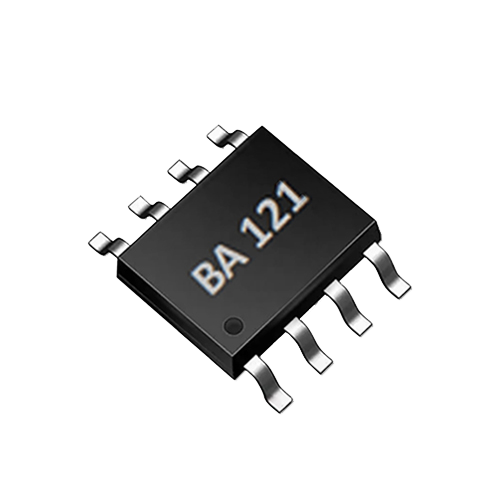
- BA121: a single-channel conductivity and water temperature ASIC with a built-in patented conductivity conversion algorithm, automatic temperature correction, single-channel conductivity detection, bipolar probe drive and very few external components. It suits compact control boards and can reduce the footprint of peripheral circuitry.
- BA234: a single-channel dual-probe interface ASIC with automatic NTC temperature compensation, bipolar pulse excitation, simple control commands and UART digital output at 9600 bps. The digital output makes it easy to communicate directly with the host controller and reduces analog front-end design.
Selection comparison:
| Feature | BA121 | BA234 |
|---|---|---|
| Channels and probes | Single-channel conductivity detection | Single-channel dual-probe measurement |
| Temperature compensation | Automatic temperature correction | Automatic NTC temperature compensation |
| Probe drive | Bipolar probe drive | Bipolar pulse excitation |
| Data interface | Not specified in the selected materials; refer to the datasheet | UART digital output 9600 bps, simple control commands |
| External components | Minimal external components | Not specified in the selected materials; refer to the datasheet |
| Applicable focus areas | Compact smart water products, reduced peripherals | Fast digital integration, dual-probe measurement |
Selection decision method:
- If the main control board already has an ADC and you want fewer peripherals, evaluate BA121; if you want fast digital integration, prioritize BA234.
- If you need dual-probe differential measurement or a more flexible probe configuration, the single-channel dual-probe measurement feature of BA234 is more suitable.
- Temperature compensation: BA121 provides automatic temperature correction, and BA234 provides automatic NTC temperature compensation; in both cases, ensure good thermal coupling between the NTC and the measured water sample.
Note: The database does not provide specific ranges, accuracy, supply voltage, or package details; actual selection must be based on the latest AtomBit datasheets and application support.
IV. Integration constraints for probes and temperature compensation
Regarding probes:
- Laundry equipment has limited flow-path space and requires compact probes; AtomBit application support provides customization of structures, wiring harnesses, interfaces, and application calibration, which can help OEMs adapt.
- Long-term exposure to detergents, fabric softeners and scale can cause scaling or contamination on the probe surface, leading to reading drift; regular cleaning or bipolar excitation to slow polarization is required.
- The installation location should avoid dead-water zones, bubble accumulation and particle impact; add a filter screen or flow-stabilizing structure if necessary.
Temperature compensation:
- Conductivity changes significantly with temperature, so automatic compensation is essential.
- The NTC thermistor should be in good thermal contact with the water sample and kept away from heat sources such as heaters and motors that could cause local temperature differences.
- The compensation model and coefficients need to be calibrated within the target water temperature range; automatic compensation cannot replace proper installation design and mass-production calibration.
Limitations:
- Conductivity can only reflect the total amount of ions and cannot distinguish calcium-magnesium hardness, sodium ions or detergent components; it needs to be combined with specific logic for judgment.
- Foam, bubbles, oil contamination and suspended solids may interfere with measurement, requiring signal filtering and exception handling.
- For extremely low conductivity (such as pure water rinsing) or extremely high conductivity (such as concentrated detergent liquid), different gains or probes may be required, and this must be determined through actual testing.
V. Hardware Integration and Implementation Steps
Recommended steps are as follows:
- Define functional requirements: list the program points, maintenance logic and after-sales data that require water-quality signal input.
- Select measurement points: evaluate three typical locations—inlet water, wash liquor and rinse drain water—and determine the number of sensors.
- Probe structure design: confirm the probe form, electrode spacing, sealing and wiring harness routing with the AtomBit application team.
- ASIC peripheral design: complete the power supply, decoupling and interface circuits according to the datasheet; BA121 requires very few external components, and BA234 connects directly to the main controller via UART.
- Software data chain: read conductivity/temperature data, apply moving average or median filtering, and remove spikes caused by air bubbles.
- Threshold setting: under the target water quality and detergent formulation, collect baseline and process data, and set the control thresholds.
- System integration testing: verify data stability and response under operating conditions such as cold water, heating, rinsing and spinning.
- Mass-production calibration: design calibration fixtures, perform single-point or multi-point calibration with standard solutions of known conductivity, and record consistency.
Six, cost and mass-production validation
Cost control:
- Using the ASIC solution can reduce the number of discrete components, PCB area and debugging time.
- Bipolar drive/pulse excitation helps extend probe life and reduce after-sales maintenance costs.
- Digital output eliminates the need for a host ADC channel, simplifying firmware.
Mass-production validation:
- Conductivity accuracy verification: use traceable standard conductivity solutions and verify reading deviation at multiple temperature points.
- Temperature compensation verification: place the sensor in a constant-temperature water bath, vary the temperature, and check the stability of the compensated reading.
- Long-term drift test: run continuously in a simulated washing-equipment operating environment and observe scaling and drift.
- EMC/interference immunity: verify UART communication and data jumps while motors, heaters and variable-frequency drives are operating.
- Batch consistency: sample and test multiple batches to evaluate the total error contributed by the ASIC, probe and mechanical parts.
VII. Limitations and Applicable Boundaries
This solution is suitable as a feedback and control signal for smart laundry equipment, but it is not suitable as a basis for water-quality safety compliance determination. Differences in regional water quality and changes in detergent composition may affect the conductivity baseline, requiring recalibration for each type of application. Probe lifetime, contamination and temperature gradients are the main limitations on long-term reliability. When selecting AtomBit BA121/BA234, verify against the latest specifications for the target range, accuracy, power supply and package.
FAQ
Q1: Can BA121/BA234 output TDS values directly? A: According to available information, BA121 provides a conductivity conversion result, and BA234 outputs a digital signal; TDS is usually converted from conductivity using a coefficient that varies with water quality and must be set in the system.
Q2: Where should the probe be installed in laundry equipment? A: It depends on the control objective. For inlet-water monitoring, install it in the inlet water line; for wash-liquor monitoring, it can be placed in the circulation line or outer tub; for rinse-effectiveness monitoring, it can be placed in the drain or rinse-water circuit. Avoid direct influence from bubbles, foam and particles.
Q3: Does automatic temperature compensation mean the effect of installation temperature can be ignored? A: No. Automatic compensation is based on an internal model and NTC measurement; the NTC must be in good thermal contact with the water sample, and calibration must cover the actual temperature range, otherwise additional error will occur.
Q4: How can the long-term reliability of sensors in laundry equipment be verified? A: In addition to calibration with standard solutions, temperature cycling, vibration, detergent immersion and long-term operation tests are required, along with regular probe cleaning.
Introducing conductivity/TDS water-quality sensing into smart laundry equipment requires a closed loop from control objectives and probe structure to ASIC selection and mass-production validation. AtomBit BA121/BA234 offers compact integrated options, but whether it can ultimately be implemented depends on application calibration and reliability validation.