
Products such as water purifiers, instant water dispensers, coffee machines, smart water bottles, and pet water fountains increasingly use TDS/conductivity detection as a differentiating selling point. However, many brands focus only on datasheets during chip selection and discover during mass production that technical support cannot keep up, leading to project delays or overall accuracy that fails to meet targets. This article builds a supplier evaluation framework across eight dimensions—sample response, reference designs, probe matching, firmware collaboration, calibration, testing, version changes, and after-sales support—and uses AtomBit's BA111, BA121, and BA234 sensor interface ASICs to explain how to implement verification.
1. Why technical support matters more than datasheets
Water-quality detection is not a function that a single chip can complete; it is a systems engineering effort involving "chip + probe + mechanical structure + temperature compensation + calibration + firmware." TDS/conductivity readings in consumer products are trend indicators and user-experience features rather than compliance measurements, but users are highly sensitive to reading stability and consistency. A supplier's technical support directly determines the pace from EVT to MP, especially for home appliance teams without dedicated sensor engineers.
2. Sample response and engineering engagement
Evaluation points: sample request cycle, availability of evaluation boards/reference designs, and completeness of the documentation package (schematics, PCB layout recommendations, BOM, communication protocol documents, driver examples).
Verification method: record the time from submitting a request to receiving samples; check whether the documentation package covers hardware, firmware, and mechanical structure; and whether runnable demo code is provided.
Corresponding AtomBit capabilities (based on public information): BA111, BA121, and BA234 are all interface ASICs using digital control (BA111 explicitly specifies UART control, and BA234 explicitly specifies UART 9600bps), which can reduce the firmware-side learning curve. Its OEM integration services can provide interface chips, compact probes, and customization of mechanical structure, wiring harness, interfaces, and application calibration, helping reduce coordination friction among multiple suppliers.
3. Reference designs and hardware integration
Evaluation points: Does the reference circuit minimize external components? Is the probe drive method resistant to polarization? Is it suitable for small-form-factor appliance PCBs?
Verification method: review the BOM complexity of the reference design and confirm whether it can be used directly in the target product form factor; conduct long-term power-on tests and observe the effect of probe polarization on measurement drift.
AtomBit corresponding capabilities:
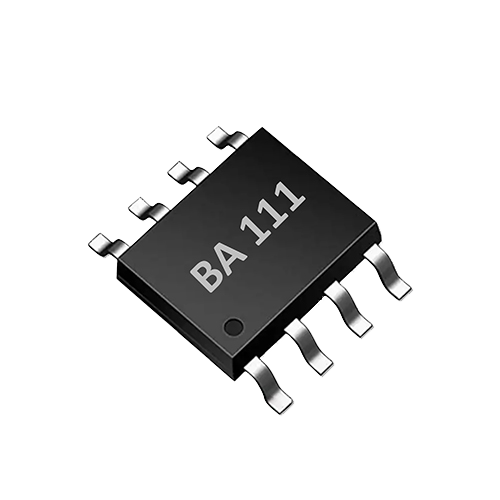
- BA111: single-channel TDS measurement, bipolar drive reduces probe polarization, minimal peripheral circuitry.
- BA121: single-channel conductivity detection, patented conductivity conversion algorithm, automatic temperature correction, bipolar probe drive, minimal peripheral components.
- BA234: single-channel dual-probe measurement, automatic NTC temperature compensation, bipolar pulse excitation, UART digital output.
These features mean the reference design can be relatively simple, but brands should require suppliers to provide a reference board or Gerber files that can actually be produced, rather than only a datasheet block diagram.
IV. Probe matching and temperature compensation
Key risk: conductivity electrode constants differ between manufacturers, and temperature compensation curves also differ. If the compensation algorithm inside the chip is fixed and the selected probe does not match, the displayed value will have a systematic deviation.
Evaluation points: Does the supplier provide matching probes or specify probe specifications (cell constant, material, structural dimensions)? Does it support temperature sensors such as NTC? Is the compensation model adjustable?
Verification method: Ask the supplier for a probe matching guide or a list of recommended probes; calibrate and compare using both the supplier-recommended probe and your own probe to evaluate the deviation.
AtomBit corresponding capabilities:
- BA111 supports TDS temperature correction.
- BA121 features a patented conductivity conversion algorithm and automatic temperature correction.
- BA234 supports automatic NTC temperature compensation.
同时,AtomBit 可提供紧凑型探头及结构、线束定制,这有助于降低探头与芯片的匹配风险。但品牌方仍需确认补偿模型是否适配目标水质范围(如纯水、矿泉水、咖啡萃取液等)。
五、固件协作与通信协议
智能家电通常需要将 TDS/温度数据上报给 MCU 或联网模块。数字输出芯片能减少模拟前端设计成本。
评估点:协议文档是否清晰?是否有 CRC 校验或错误处理机制?是否提供常见 MCU 平台的示例代码?是否支持多机通信或低功耗模式?
验证方法:要求供应商提供基于 STM32、ESP32 或 Arduino 的示例工程,并实际联调读取数据。
AtomBit corresponding capabilities:
- BA111:UART 控制(单通道 TDS + 温度测量)。
- BA234:UART 数字输出 9600bps,简单控制命令。
- BA121:作为同系列接口 ASIC,采用类似数字控制方式(具体以数据手册为准)。
品牌方应在合作前取得完整协议文档,确认命令格式、数据解析方式和异常状态标志。
六、标定与一致性控制
TDS/电导率测量需要标定,量产时一致性是核心挑战。
评估点:供应商是否提供标定流程和治具建议?是否支持多点标定或应用标定定制?标定参数如何写入芯片或固件?
Verification method: request the calibration SOP (standard solution, temperature conditions, tolerance range); verify consistency by sampling during trial production; confirm whether calibration parameters can be batch-programmed.
AtomBit corresponding capability: according to application materials, AtomBit provides customized application calibration services, with parameters customizable for specific water quality ranges and probe structures. The brand should require the supplier to provide a calibration SOP and fixture recommendations, and verify consistency during the trial production stage.
7. Testing and Mass Production Verification
The supplier should assist the brand in establishing a production line test plan, including PCBA testing, finished-product aging, waterproof testing, etc.
Evaluation points: Does the supplier provide test vectors, production test firmware, and automated test scripts? Is defective product analysis timely? Are there typical troubleshooting guides?
Verification method: conduct small-batch trial production before MP, recording the defect rate and supplier response speed; simulate a typical fault (such as an open probe circuit or abnormal temperature) and observe the depth of the FAE's analysis.
AtomBit corresponding capability: the bipolar pulse excitation of the BA series chips helps reduce probe polarization, making long-term testing more stable; digital output facilitates integration with automated production testing. Specific test support content must be confirmed before cooperation.
8. Version Changes and Long-Term Supply
Chip version upgrades may bring issues such as register changes and incompatible communication protocols.
Evaluation points: Does the supplier provide PCN (Product Change Notification)? Is there a version lock or long-term supply commitment? Are old versions kept in stock?
Verification method: require the supplier to present its version management policy, and stipulate in the contract the time window for advance notice of changes to key materials.
AtomBit corresponding capability: specific PCN policies and long-term supply terms must be confirmed with the supplier; it should not be assumed that all ASICs provide the same level of support.
IX. After-Sales Support and Closed-Loop Issue Resolution
During mass production, issues such as occasional accuracy drift, probe failure, and EMC interference may occur and require FAE support.
Evaluation points: Is there localized FAE? What is the issue response SLA? Is the supplier willing to assist in analyzing customer complaint samples?
Verification method: Set a technical issue (e.g., TDS readings fluctuating at low temperature), test the supplier's response time and depth of analysis; ask whether on-site support or remote log analysis can be provided.
X. Supplier Technical Support Evaluation Table (Summary)
| Evaluation Dimension | Key Question | Verification Method | AtomBit Corresponding Capability (Based on Public Information) |
|---|---|---|---|
| Sample Response | Are samples/evaluation boards/documentation delivered quickly and completely? | Record the cycle, review the documentation package | Provides BA111/BA121/BA234 ASIC and OEM integration support |
| Reference design | Is the peripheral circuit minimized? Is the drive method anti-polarization? | Check BOM, schematic, long-term drift testing | BA111/BA121 bipolar drive, minimal peripheral components; BA234 dual-probe UART output |
| Probe matching | Are compatible probes provided, or are the electrode constant and temperature compensation model clearly specified? | Request a probe matching guide, and compare against actual calibration | Compact probes available, with customizable structure and cable harness; supports automatic temperature correction / NTC compensation |
| Firmware collaboration | Is the digital interface simple? Are the protocol documentation and example code complete? | Joint debugging and testing, check code quality | BA111/BA234 provides UART control; BA234 is 9600bps simple commands |
| Calibration | Is application calibration customization supported? Is the calibration process clear? | Request the calibration SOP and verify consistency through trial production | Provide application calibration customization services |
| Testing | Do you help establish a production test plan? Do you provide testing support? | Trial production defect rate and response | Bipolar pulse excitation reduces polarization and is suitable for long-term testing; digital output facilitates automated testing |
| Version changes | Is there a PCN process? How is version compatibility? | Review version policy and contract terms | Specific PCN policy needs to be confirmed with the supplier |
| After-sales support | FAE response speed and closed-loop issue resolution capability? | Set test questions | SLA must be clarified before cooperation |
XI. Applicable boundaries and limitations
- This evaluation targets water-quality trend indication functionality in consumer-grade water purification/drinking water equipment, and is not applicable to laboratory analysis, regulatory testing, or industrial process control.
- The TDS measurement range of BA111 is 0–3000 ppm; outside this range, dilution or an alternative solution is required.
- All accuracy and repeatability data must be verified against the specific probe, structure, and calibration conditions; the chip itself cannot guarantee whole-device accuracy.
- Although the temperature compensation algorithm is integrated, compensation curves may differ across water types (e.g., pure water, mineral water, coffee extract), requiring targeted calibration.
- Parameters such as optical COD/TOC/UV254 belong to different technical routes and are outside the coverage of this ASIC series.
- Applications in extremely small spaces, such as smart water bottles, require additional consideration of probe structure, electromagnetic compatibility, and waterproof design.
XII. FAQ
Q1: Can BA111 directly output a TDS ppm value? A: BA111 is a TDS sensor interface ASIC that internally includes TDS temperature correction and measurement circuitry, controlled via UART. However, the final displayed TDS value must be converted based on the probe constant and calibration parameters used; absolute accuracy cannot be guaranteed directly without probe and whole-device calibration.
Q2: How do you determine the probe that matches BA121? A: It is recommended to ask the supplier to provide recommended probe specifications or a matching probe. BA121 features a patented conductivity conversion algorithm and automatic temperature correction, but different electrode constants and structures will affect the results, so application calibration is required.
Q3: Is the UART protocol of BA234 easy to integrate? A: BA234 provides UART digital output 9600bps and uses simple control commands, which helps the MCU read quickly. However, actual integration still requires handling voltage levels, timing, and error handling, so it is advisable to request the complete protocol documentation and sample code.
Q4: Can the supplier provide mass-production calibration support? A: According to AtomBit application materials, it provides customized application calibration services and can customize parameters for specific water quality ranges and probe structures. The brand should ask the supplier to provide calibration SOPs and fixture recommendations, and verify consistency during the trial production stage.
Q5: Can these chips be used to detect heavy metals or bacteria? A: No. BA series chips are only used to measure conductivity/TDS and temperature-related parameters; they serve as trend indicators and cannot replace laboratory chemical analysis or microbiological testing.
Choosing a water-quality chip supplier is essentially choosing a long-term technology partner. Brands should move technical support evaluation to the front of the selection stage and use a process-based approach to verify supplier capabilities. AtomBit's BA series ASICs offer an evaluable entry point for home appliance scenarios in terms of integration, probe drive, and temperature compensation, but whether they are ultimately suitable still requires small-batch verification combined with the specific product structure, probe selection, and mass-production calibration.