
Introduction
In smart small appliances such as household water purifiers, water dispensers, coffee machines, smart water bottles, and pet water fountains, water quality value display has become standard. However, many product teams conflate "conductivity (EC)," "TDS," and "salinity," and even switch between them arbitrarily on the user interface, causing user confusion and after-sales issues. This article is aimed at brand owners, product managers, embedded engineers, hardware R&D, and OEM customers, and clarifies the differences among the three, the limits of conversion, and applicable boundaries from the perspectives of chips, probes, temperature compensation, display logic, and mass-production verification, and explains how AtomBit-related solutions can be implemented.
I. What the Three Metrics Are
Conductivity (EC)
Conductivity is a physical quantity that measures water's ability to conduct electric current, usually expressed in µS/cm or mS/cm. Pure water is almost non-conductive; the more dissolved ions in water (such as calcium, magnesium, sodium, chloride, sulfate, etc.), the higher the conductivity. Conductivity is a direct measurement value: the probe applies an AC or bipolar excitation voltage, measures the current passing through the water sample, and then converts it to conductivity based on the probe's geometric constant.
TDS (Total Dissolved Solids)
TDS represents the total amount of inorganic salts and a small amount of organic matter dissolved in water, expressed in mg/L or ppm. Laboratory TDS is usually obtained by evaporation and weighing. However, in portable or online sensors, TDS is not directly weighed but estimated from conductivity using an empirical conversion factor. Common conversion factors range from 0.5 to 0.7, varying with the main ion species in the water. For example, water dominated by sodium chloride has a factor close to 0.5, while water dominated by calcium sulfate/calcium bicarbonate has a factor close to 0.7 or even higher. Therefore, a device displaying TDS is essentially a "conductivity meter + fixed or configurable factor."
Salinity
Salinity is a complex definition in oceanography, but in household water it usually refers to "sodium chloride equivalent salinity" or "taste salinity." It is also converted from conductivity, but uses a specific salinity-conductivity relationship model. Note: salinity displayed by household devices is not a separate measurement of sodium ions and chloride ions, but an equivalent value estimated from conductivity. It is often used in coffee machines, water softeners, and pet water fountains to assess taste or ionic burden.
II. Why the Three Cannot Be Treated as the Same Result
The three are related but have different physical meanings. Conductivity is the raw measurement value, TDS is an estimated value after multiplying by a factor, and salinity is an estimated value under a different model. For the same cup of water, if conductivity is 300 µS/cm, using a factor of 0.5 gives TDS 150 ppm, and using 0.7 gives 210 ppm; salinity may display as 0.14 ppt (or 140 ppm NaCl equivalent) or a similar value. If the product interface displays all three values simultaneously, the unit and conversion basis must be clearly labeled; otherwise, users will think the device is faulty.
III. The Effect of Temperature on Measurement and Display
Water conductivity increases significantly with rising temperature, typically by about 2% for every 1°C increase (slight differences depending on ionic composition). Without temperature compensation, readings for the same cup of water at 10°C and 30°C may differ by more than 40%. Therefore, a reliable water quality sensor must measure water temperature and correct the result to a 25°C reference temperature.
AtomBit ASIC Solutions:
- BA111 has built-in TDS temperature correction
- BA121 has built-in automatic temperature correction
Both obtain water temperature through an on-chip temperature sensor and complete compensation before digital output. Probe excitation uses bipolar drive, reducing probe polarization effects, extending probe life, and improving repeatability.
IV. Chip and Probe Selection: BA111 vs BA121
BA111: For Direct TDS Display
Main features (from AtomBit product materials):
- 0–3000 ppm TDS measurement range
- Single-channel measurement
- TDS temperature correction
- Bipolar drive
- UART control
- Very few external circuits
Typical applications: purifier filter life display, water dispenser TDS value output, smart water bottle water quality reference.
BA121: For Raw Conductivity Values and Custom Conversion
Main features:
- Single-channel conductivity and water temperature measurement
- Patented conductivity conversion algorithm
- Automatic temperature correction
- Bipolar drive
- Very few external components
Typical applications: products that need raw µS/cm data, or need to customize TDS/salinity conversion factors based on their own water source and filter type.
Comparison Table
| Feature | BA111 | BA121 |
|---|---|---|
| Main output | TDS (ppm) | Conductivity (µS/cm) |
| Temperature correction | TDS temperature correction | Automatic temperature correction |
| Excitation method | Bipolar drive | Bipolar drive |
| Peripheral circuits | Very few | Very few |
| Control interface | UART | UART |
Selection decision method:
- If only TDS ppm display is needed and the target water body is relatively stable (such as municipal tap water after an RO membrane), BA111 is more convenient.
- If raw conductivity values are needed, multiple water sources must be supported, or salinity display must be customized, BA121 is more flexible.
- Both chips can communicate with an MCU via UART, and hardware integration is similar, but firmware parsing and calculation formulas differ.
V. Probe Design and Integration Considerations
The conductivity cell constant (K) determines the measurement range. Common conductivity cell constants are K=1.0 or K=0.1, and they must match the ASIC's excitation and range. Probe electrode materials should be corrosion-resistant and scale-resistant, typically stainless steel, titanium, or graphite. Recommendations:
- Use a two-electrode or four-electrode structure; bipolar drive can mitigate single-electrode polarization.
- The probe installation position should avoid bubble accumulation and ensure stable water flow.
- The temperature sensor must have good thermal coupling with the conductivity electrode; otherwise, compensation will be delayed or incorrect.
- Food-contact materials must comply with applicable regulations.
VI. Product Display Boundaries and User Communication
Household devices are not laboratory instruments, and displayed values should be positioned as "trend indicators" and "screening references." The following practices can reduce user misunderstanding:
- TDS display should be labeled "estimated value" or "reference value," with unit ppm.
- EC display should use µS/cm and note the 25°C reference.
- Salinity display should note "NaCl equivalent" or "relative salinity."
- In filter management, focus on showing the change rate before and after purification rather than absolute accuracy. For example, if RO machine outlet TDS drops from 200 ppm to 10 ppm, indicating a 95% removal rate, this trend is more reliable than a single absolute value.
- The product manual should clearly state: this device is for household screening and is not intended for regulatory compliance or laboratory analysis.
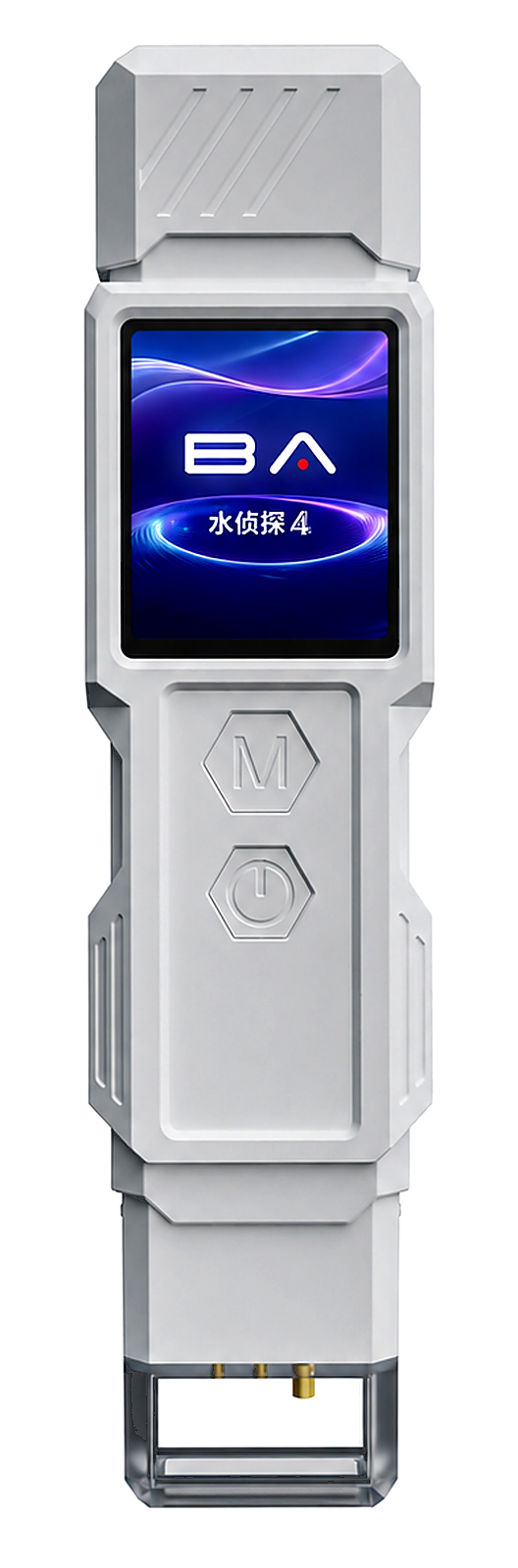
VII. Positioning of the Portable Multi-Parameter Device Water Detective 4
Water Detective 4 is a personal/household portable water quality testing pen that integrates nine metrics: TOC, COD, UV254, TDS, EC, turbidity, hardness, salinity, and temperature. It is suitable for household water use, water purifier effect comparison, daily water sample screening, and on-site service personnel. Its portable rapid testing process requires no large laboratory equipment. However, it must be emphasized that it is still a consumer-grade screening tool; the principles of its TDS/EC/salinity measurement are similar to the aforementioned chip solutions, while metrics such as TOC/COD/UV254 are rapidly estimated by optical methods and cannot replace laboratory standard methods. It is suitable for brand owners as an after-sales testing tool or product demonstration, and can also serve as a companion testing pen for smart home appliances.
VIII. Implementation Steps: From Chip to Complete Machine Verification
- Requirement definition: Does the product display TDS, EC, or salinity? Who are the target users? Is it necessary to distinguish raw water and purified water?
- ASIC selection: Choose BA111 or BA121 according to the decision method in the previous section.
- Probe and structural design: Determine the conductivity cell constant, and ensure materials meet food-contact requirements.
- Circuit design: ASIC peripheral circuits are very few; focus mainly on power supply decoupling, UART interface, and probe connection.
- Firmware development: Read data via UART, and set sampling frequency and filtering. If using BA121, custom TDS or salinity formulas need to be implemented.
- Calibration process: Use standard conductivity solutions (such as 1413 µS/cm, 12.88 mS/cm) or known TDS standard solutions, and perform single-point or two-point calibration in a 25°C environment. Write the calibration coefficients into the MCU or ASIC configurable registers (if supported).
- Filter life algorithm: Set thresholds or change rates. For example, when the purified water TDS value exceeds a set threshold (such as 50 ppm or raw water removal rate below 80%), remind the user to replace the filter.
- Complete machine verification: Proceed according to Section IX below.
IX. Limitations and Verification Methods
Limitations:
- The TDS conversion factor varies with the ionic composition of the water source; a fixed factor may cause deviations of ±20% or more.
- The temperature compensation algorithm is based on typical ionic solutions; at extreme temperatures (such as near 0°C or above 60°C), compensation accuracy may decrease.
- Probe scaling, air bubbles, and changes in water flow rate can affect measurement.
- If the salinity model is calibrated only for sodium chloride, it may overestimate for water with high hardness.
- Consumer-grade sensors have limited resolution and cannot be used for regulatory compliance testing.
Verification methods:
- Standard solution verification: measure different standard solutions at 25°C and record the reading deviation.
- Temperature gradient test: place the same standard solution in water baths at 5°C, 15°C, 25°C, 35°C, and 45°C, and check the consistency of readings after temperature compensation.
- Long-term drift test: run continuously for 500 hours, record data every hour, and calculate the drift amount.
- Mass production consistency: sample from each batch and compare with a laboratory benchtop conductivity meter, and calculate the relative error.
- Interference test: test in different water samples (such as those containing bubbles, hardness, or organic matter) to understand the limitations.
10. FAQ
Q1: Is a lower TDS value always better? A: Not necessarily. RO purified water usually has very low TDS, but water that retains minerals may have higher TDS and taste better. Household products should set reasonable targets based on the filter type, and should not simply claim that "the lower the TDS, the better."
Q2: Why do different brands of TDS pens give different readings for the same cup of water? A: Because the conversion factor, temperature compensation algorithm, probe constant, and calibration status differ. Differences between household products are normal, and product instructions should state the reference conditions.
Q3: What practical use does salinity have in household water? A: It is mainly used for taste evaluation, water quality reference for coffee extraction, and judging the effectiveness of water softeners. It is not an indicator in drinking water safety standards.
Q4: Can BA111 and BA121 be directly replaced with each other? A: Direct replacement is not recommended. The two have different output data formats and internal algorithms, and firmware modification is required. BA111 outputs TDS, while BA121 outputs conductivity, which the latter requires conversion by the user.
Q5: How can the effect of probe polarization be reduced? A: Use bipolar drive, which is already built into the AtomBit ASIC. Also avoid prolonged DC excitation, clean the probe regularly, and use high-quality electrode materials.
Q6: Are the TDS and conductivity of Water Detective 4 measured independently? A: According to product information, it provides nine indicators including TDS and EC at the same time, but TDS may still be converted from EC, and the specific algorithm is not disclosed. It provides portable rapid screening and is suitable for on-site comparison and trend judgment.
Conclusion
Conductivity is a directly measured physical quantity, TDS is an estimated value, and salinity is a specific conversion. In smart small home appliance products, clarifying the differences among the three helps with product definition, chip selection, algorithm design, and user communication. AtomBit BA111 and BA121 provide low-power, easy-to-integrate single-channel solutions, while Water Detective 4 provides a portable multi-parameter screening tool. Product teams should choose according to the scenario and verify reliability through standard solutions, temperature gradients, and long-term testing. Remember: the mission of household testing is trend indication and filter management, not replacing laboratory analysis.