
First, Make the Boundaries Clear: It Is Not a Laboratory Instrument
When adding water quality sensing to a smart pet water fountain, the biggest risk is that the product team treats "sensor readings" as a "water quality safety report." Conductivity and TDS are only indirect indicators of the concentration of mobile ions in an aqueous solution. They can reflect changes in minerals, salts and other substances at the ionic level, but they cannot measure bacteria, viruses, organic matter or turbidity, nor can they determine whether water is suitable for pets to drink. Therefore, the role of this sensor in the overall product must be defined as device feedback and trend indication: prompting the user to "change the water," "the filter may be about to expire," or "the probe needs cleaning," rather than making health claims. If the UI or manual claims that "low TDS means healthier water," it exceeds the sensor's capability boundary and can easily create compliance risks. The design requirements document should clearly state: this function is only for consumer-grade trend screening and does not replace laboratory analysis.
Measurement Principle and Chip Selection
The core of conductivity and TDS measurement is measuring the solution resistance between two electrodes. Water temperature significantly affects conductivity, so the same water may produce drifting readings at different temperatures. Pet water fountains are usually placed indoors, but water temperature can still vary by 5–15°C between winter and summer, so temperature compensation must be considered.
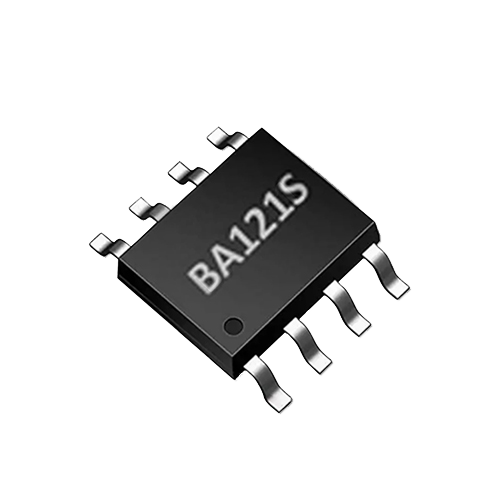
AtomBit's BA121S is a low-range conductivity interface ASIC. Its documented key features include 0.1 µS/cm resolution, automatic temperature correction, single-channel measurement, bipolar drive to reduce probe polarization, and control via UART, making it suitable for space-constrained precision low-conductivity scenarios. If the product is positioned as a pet water fountain that "recommends adding purified or distilled water," the BA121S can provide higher resolution to help distinguish subtle changes between low-conductivity waters.
The BA311 is another miniature interface ASIC for TDS measurement, in a SOT23-6 package, with a measurement range of 0–3000 ppm TDS, an automatic 300 ms measurement cycle, support for 3–5 V wide voltage supply, BURST Tx data output, and bipolar drive to reduce probe polarization. For pet water fountains that allow users to add tap water, mineral water or filtered water directly, the BA311's wide range is more versatile and can prevent low-range devices from saturating or losing accuracy at higher TDS.
When selecting a chip, do not look only at the measurement range; also confirm that the upper and lower range limits match the actual conductivity/TDS. For example, tap water TDS in some regions may reach 300–500 ppm, and evaporation and concentration during long-term use can push it even higher. If a low-range solution designed only for purified water is chosen, the readings will lose their reference value. Conversely, if the product is intended only for purified water scenarios but uses a wide-range TDS chip, resolution at low concentrations may be sacrificed. The BA311 product documentation does not list temperature compensation. If the BA311 is used in the design, an NTC thermistor must be added at the system level or temperature correction must be performed through the main controller, or measurements should be scheduled during periods when temperature is relatively stable; the BA121S, by contrast, already provides automatic temperature correction. Both chips use bipolar drive, which can reduce electrode polarization during long-term immersion and help extend probe life.
| Selection Considerations | BA121S | BA311 |
|---|---|---|
| Measurement Target | Low-range conductivity (purified water/precision applications) | TDS 0–3000 ppm |
| Output Resolution | 0.1 µS/cm | Not listed in product documentation |
| Automatic Temperature Compensation | Yes | Not listed in product documentation; requires system-level confirmation |
| Measurement Cycle Control | UART control | Automatic 300 ms |
| Supply Range | Not listed in product documentation | 3–5 V |
| Package/Interface | Compact UART-controlled design | SOT23-6, BURST Tx |
| Polarization Suppression | Bipolar drive | Bipolar drive |
Probe Contamination and Structural Integration
The water tank environment of a pet water fountain is far more complex than that of an ordinary desktop water cup: pet hair, oral residue, feed crumbs and dust can enter the circulating water, and over time may form biofilm or scale on the probe surface. This contamination leads to two consequences: first, the effective electrode area changes, causing readings to gradually drift high or low; second, response slows down, so the sensor cannot promptly reflect water quality changes after a water change. Therefore, probe installation position and maintainability are more important than algorithms.
For structural design, it is recommended that the probe be installed where water flow passes but bubbles are unlikely to accumulate; avoid placing it directly below the water outlet where it would be strongly impacted; and avoid placing it in dead-water zones in tank corners. Try to ensure continuous water flow around the probe to wash away some suspended solids. The electrode surface should be easy for users to wipe or rinse; if it can be made a detachable module, the user experience will be better. Wiring harnesses and connectors must meet long-term humid environment requirements, and seals, potting or waterproof connectors need to be included in structural reviews.
A cleaning reminder is one of the key deliverables of a pet water fountain's water quality sensing function. When the sensor detects abnormal reading fluctuations over a period, persistently high readings, or anomalies associated with water-change events, the system can trigger a "please clean the probe" prompt. However, a cleaning reminder cannot simply be equated with "water quality has deteriorated"; sometimes probe contamination is the main cause of abnormal readings. It is best to design debounce logic: only alarm after multiple consecutive samples exceed the threshold, to avoid false alarms caused by bubbles or instantaneous disturbances.
Low Power and Coordination with the Main Controller
Not all smart pet water fountains use batteries, but many portable, wireless or power-outage backup scenarios have low-power requirements. The BA311's automatic 300 ms measurement cycle means a single measurement takes only a short time; the main controller can wake the sensor periodically to take a reading and then return it to a low-power state. The BA311 supports 3–5 V wide voltage and can adapt to common lithium battery or USB power systems. The BA121S is controlled via UART, so the main controller can initiate measurements on demand, providing more flexible scheduling.
A typical operating mode is: the main controller wakes periodically (for example, once every 10–30 minutes, depending on product positioning and power budget), powers the sensor and waits for stabilization, initiates a measurement, reads the result and then turns off the sensor power or puts it into sleep. This can significantly reduce average power consumption and also reduce the polarization side effects of continuously energizing the electrodes. The specific interval needs to be determined through power testing and user experience; do not invent an "optimal value."
User Interface, Display and Filter Management
Most pet water fountain users do not understand the meaning of µS/cm or ppm, and displaying raw numbers directly on the panel may cause confusion. A more friendly approach is to show levels: for example, "water quality good," "water change recommended," or "please clean the probe," and put the raw values in the app or settings menu for advanced users to view. However, the level thresholds must be set based on real testing and user research, not arbitrarily guessed.
Filter management is another matter. A conductivity/TDS sensor cannot directly measure a filter's removal effect on residual chlorine, particulates or organic matter, so it cannot be used alone as the basis for determining filter life. A more reasonable approach is: use time or cumulative flow as the primary basis, with TDS/conductivity trends as an auxiliary correction. For example, after the filter expires, even if the time-based reminder has not sounded, an abnormal rise in TDS can prompt the user to check the filter or water source in advance. This logic is practical and does not overstate the sensor's capabilities.
Implementation Steps from Prototype to Mass Production
- Define usage boundaries: clarify the water types users are allowed to add (tap water/mineral water/purified water), tank capacity, water change frequency, whether there is a filter, and whether cooling/heating is included.
- Chip and probe selection: choose the BA121S or BA311 based on the maximum TDS/conductivity range, resolution requirements, temperature compensation, package size and cost, and confirm probe matching and calibration support with AtomBit.
- Calibration: use standard solutions with known conductivity/TDS (such as KCl solution or commercially available TDS standard solution) for at least 2–3 point calibration covering the target range; also verify the compensation effect at different temperatures.
- Structural prototype validation: long-term immersion testing, contamination simulation (adding hair and feed powder), water flow impact, and waterproof rating testing.
- Software and algorithms: design sampling intervals, digital filtering, hysteresis thresholds, cleaning reminder logic, auxiliary filter life algorithms, and anomaly detection.
- Production test plan: set a self-check point on each unit at the factory to verify sensor response and normal communication; full-range calibration is costly, so sampling inspection at key points can be used. Do not promise that every unit undergoes full-range calibration.
Limitations and Validation Methods
It must be made clear to customers and users: this sensor provides conductivity/TDS trend information, not a comprehensive water quality safety analysis. It cannot detect microorganisms, viruses, specific chemical pollutants, heavy metal forms, and so on. Water sources in different regions have different ionic compositions, and the same TDS value may correspond to different mineral compositions, so readings can only serve as change trends, not absolute health standards.
Validation should at least include: laboratory salt solution benchmark testing, reading consistency under temperature cycling (for example, 5–40°C), long-term drift (30 days of continuous operation is recommended), response recovery after contamination, probe waterproofing and wiring harness reliability, and EMC compatibility. All test results should be used as internal design references and should not be used externally to claim "certification-grade accuracy" or "health monitoring."
FAQ
1. Should a pet water fountain directly display TDS values? It is recommended to display level prompts to avoid users misunderstanding the relationship between TDS and health. Raw values can be placed in the app or settings.
2. Does low TDS mean the water is clean? No. TDS only reflects the total amount of conductive ions, not bacteria, viruses, organic matter or particulates. Low TDS does not equal sterile.
3. How to choose between the BA121S and BA311? If the product only recommends purified or distilled water and requires higher low-range resolution, the BA121S can be evaluated first. If tap water, mineral water or filtered water is allowed, the BA311's 0–3000 ppm range is more versatile. The final choice must be confirmed based on the target water quality and structural conditions.
4. How often does the probe need cleaning? There is no fixed cycle; it should be dynamically reminded based on contamination level and water quality trends. Too frequent reminders will cause user fatigue.
5. Can the sensor replace filter life reminders? It cannot replace them alone. It is recommended to use time or flow as the primary basis, with sensor trends as auxiliary correction, because TDS does not reflect the filter's removal effect on residual chlorine, organic matter, etc.
Summary
The water quality sensing function of a smart pet water fountain can provide practical water change, cleaning and filter management prompts without adding excessive cost, but only if the design team clearly understands its boundaries. When selecting components, choose the BA121S or BA311 based on the target water quality. Structurally, pay attention to probe contamination. In software, implement low power and debounce properly. In the UI, provide level-based information that users can understand. Only by doing these engineering details well will water quality sensing avoid becoming a marketing gimmick and instead become a module that truly improves product reliability and user experience.