
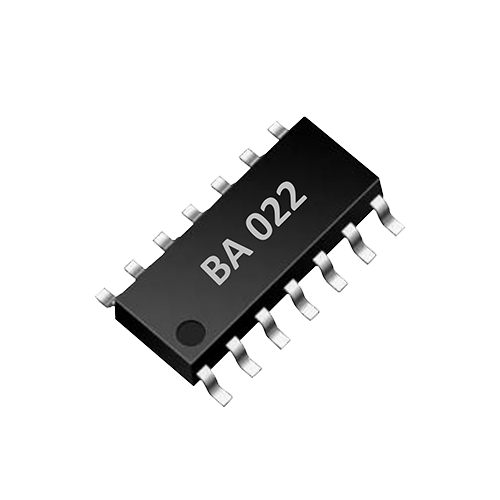
In products such as water purifiers, water dispensers, coffee machines, smart water bottles and pet water dispensers, conductivity/TDS measurement is often used to quickly assess water quality, manage filter status and enhance the user experience. Single-point measurement can support basic display, but cannot answer questions such as "how do inlet and outlet differ" or "are the two water paths consistent". BA022 is a dual-channel conductivity interface ASIC introduced by AtomBit for such devices, integrating two 0–6000 µS/cm measurement channels, 0–100 °C automatic temperature compensation and bipolar probe drive, suitable for RO systems, hydrogen water machines and tap water equipment. This article outlines a practical design approach covering product definition, hardware interface, calibration, display, filter management and mass-production validation.
Why dual channels have practical value in household water purification and smart water appliances
In RO water purifiers, users care not only about outlet TDS but also about whether the filter is effective; measuring only the product water shows "low TDS" but cannot reveal how changes in inlet water quality affect the filter. Dual channels can sample inlet and product water simultaneously or in turns to obtain a trend-based estimate of salt rejection. Hydrogen water machines, mixed water paths or dual-outlet products also need to compare the difference between two water streams.
| Application Scenario | Single-channel solution | BA022 dual-channel solution |
|---|---|---|
| RO water purifier TDS display | Displays only product water or raw water, making comparison difficult | Reads inlet and product water simultaneously, aiding calculation of salt rejection trends |
| Hydrogen water machine or functional water equipment | Measures only one path, cannot determine electrolysis or mixing status | Two parallel comparisons to help judge mixing/electrolysis differences |
| Multiple water qualities or multiple water outlet devices | Requires polling switching or adding chips | Two channels on a single chip, reducing BOM and wiring complexity |
Key capabilities and hardware interfaces of BA022
The main features of BA022 include: two 0–6000 µS/cm conductivity channels, 0–100 °C automatic temperature compensation, bipolar probe drive to reduce polarization, and a compact reference design controlled via UART. For actual integration, it is recommended to place the chip or reference board away from strong interference sources such as water pumps, solenoid valves and relays, keep the analog probe wires as short as possible, and route them separately from power/motor wiring.
Bipolar probe drive helps reduce the impact of electrode polarization on long-term stability, making it suitable for smart water appliances that require continuous monitoring or frequent sampling. The host MCU obtains channel data via UART and does not need to build complex AC excitation and amplification circuits itself, which reduces the workload of embedded firmware and hardware debugging. The probe wiring, excitation configuration and temperature sensing connection method need to be confirmed according to the AtomBit reference design.
Selection of dual-channel measurement points and product definition
Before starting the design, you should first clarify the question the product needs to answer: is it to display single-channel TDS, or does it need to compare the difference between two channels? Is it for filter life reminders, or only for water quality trend display? The choice of measurement points directly affects the value of the dual channels.
Taking an RO water purifier as an example, a common arrangement is to place channel 1 at the pre-filter or inlet side, and channel 2 after the RO membrane or at the outlet side. This gives the conductivity of the inlet water and the produced water, which can be used to roughly judge the membrane's rejection trend. Note, however, that measurement error increases for low-conductivity samples, so a single difference value cannot be used to determine absolute filter failure. For hydrogen water machines or functional water devices, the two channels can be placed before and after treatment, or before and after mixing, according to the actual water path, to verify the consistency of the device status.
Whichever measurement points are used, the water path structure should prevent unintended electrical connections or bubble interference between the two probes. The dual-channel design of BA022 is not equivalent to electrical isolation; the two channels share the chip ground, and if there is sufficient conductive connection between the two media through metal piping or a common water path, crosstalk may be introduced, so isolation must be addressed in the structure and water path.
Calibration, display and TDS notes
Conductivity and TDS are not the same physical quantity. BA022 outputs conductivity data; the mg/L value for TDS is usually converted from conductivity by multiplying by an empirical coefficient, but that coefficient is affected by ion composition, water temperature and regional water quality, and is not a fixed constant that is the same for all water sources. Consumer-grade products can perform application calibration under the water quality conditions of the target market and the product's water-use conditions, and then display a trend-based reference value, but it should not be treated as laboratory analysis or compliance determination data.
| Display target | Suggested output | Engineering notes |
|---|---|---|
| Engineering commissioning or after-sales interface | Conductivity µS/cm, with temperature displayed at the same time | Raw data, for judging sensor and device status |
| User main interface | TDS reference value or water quality grade | Displayed after application calibration; must be marked as a reference value or screening value |
| Filter status page | Two-channel comparison, trend curve or status icon | Based on thresholds and trends, not directly equivalent to filter life |
In UI design, avoid wording such as "passed testing" or "safe" that can easily cause misunderstanding. For consumer-facing water quality displays, it is recommended to clearly label values as "reference values" and prompt users to rely on local drinking water standards or periodic laboratory testing. The automatic temperature correction capability of BA022 can help reduce errors caused by water temperature fluctuations, but the consistency of the probe and the complete unit still needs to be verified within the actual water temperature range.
Application logic of dual channels in filter management
One of the most common values of dual channels is trend comparison between inlet water and produced water. During software development, the difference or ratio between the two channels can be calculated and combined with data such as cumulative water usage, operating time and flow rate to generate filter maintenance prompts. However, conductivity can only reflect the retention trend of ionic substances and cannot reflect all filter performance such as particles, microorganisms and organic pollutants.
When inlet water or produced water falls below a certain low-conductivity threshold, the calculation of the difference between the two channels loses engineering significance, and the firmware should enter a "low conductivity, cannot determine" or "hold last state" logic to avoid false alarms. Filter life prompts should also have a redundancy mechanism, for example setting forced reminders based on usage time or water throughput, rather than relying only on the conductivity difference.
Mass production verification and consistency testing
During the R&D stage, standard solutions with known conductivity and a constant-temperature water bath can be used to verify the linearity, repeatability and temperature compensation of BA022. It is recommended to inject different standard solutions into the two channels separately to confirm that crosstalk between channels meets design requirements. Typical temperature points across the 0–100 °C chip operating range also need to be covered, but the actual probe, wiring and water path materials may be more sensitive to temperature, so complete-unit test results should prevail.
The mass production stage focuses more on consistency and mistake-proofing. A fixture can be designed to test both channels simultaneously, inject a standard solution with fixed conductivity and read UART data to automatically determine whether values are within the allowed tolerance. The complete unit also needs to verify whether conductivity readings show abnormal jumps when equipment such as pumps, solenoid valves and heating tubes start or stop. Long-term drift can be observed through sampling aging tests, for example comparing against a handheld conductivity meter after continuous water flow or immersion.
Implementation process recommendations
It is recommended to proceed according to the following steps:
- Define the measurement points and product goals: is it single-channel TDS display, dual-channel comparison, or filter cartridge management?
- Select the probe and structural approach, confirming wetted materials, cable harness length and installation method.
- Build a prototype based on the BA022 reference design, connect UART to the main controller, and complete basic readings.
- Perform application calibration using the target water quality and temperature range, and define the display logic and thresholds.
- Implement UI filtering, exception handling and filter cartridge reminder logic.
- Complete baseline verification, whole-unit EMC/interference testing and long-term flow-through testing.
- Develop a mass-production test plan covering dual-channel consistency, temperature compensation and UART communication self-checks.
Applicable boundaries and limitations
The dual-channel range of BA022 is 0–6000 µS/cm, and it mainly targets RO systems, hydrogen water machines and tap-water-related equipment. Do not use it for seawater, concentrated brine, industrial wastewater or high-conductivity process liquids. Even though the chip itself supports temperature correction from 0–100 °C, the applicable temperature, pressure resistance and chemical compatibility of the actual probe and water-path materials must be verified separately.
In addition, the dual channel provides consumer-grade screening and trend indication, not laboratory analytical instrumentation. It cannot replace hygiene permits, water quality test reports or metrological certification. Product managers and R&D teams need to clearly distinguish "device feedback", "trend reminders" and "compliance testing" when designing copy and user manuals.
FAQ
Q1: Can BA022 directly display TDS in mg/L? A: BA022 outputs conductivity data. TDS is an empirical converted value and must be calibrated for the target water quality and application before display; it is intended only for consumer-grade screening or trend reference and should not be used as laboratory or compliance data.
Q2: Can the two channels measure different water paths at the same time? A: Yes. BA022 provides two measurement channels from 0–6000 µS/cm, suitable for multi-point and comparative measurement, such as RO feed water versus product water, or comparing two paths on a hydrogen water machine.
Q3: Is temperature compensation automatic? Is an additional temperature sensor required? A: BA022 has 0–100 °C automatic temperature correction capability; in an actual system, a temperature sensor still needs to be connected per the reference design or a probe with temperature functionality must be used, and it must be verified within the target water temperature range.
Q4: What products is it suitable for? A: It is suitable for RO water purifiers, hydrogen water machines, and tap water related equipment, as well as smart water appliances that require dual-channel conductivity/TDS display; it is not suitable for high-conductivity scenarios such as seawater and industrial wastewater.
Q5: How is consistency ensured during mass production? A: Use conductivity standard solutions and a constant-temperature water bath to verify channel linearity, repeatability, and temperature compensation; at the system level, verify motor/pump interference, water path crosstalk, and long-term drift.